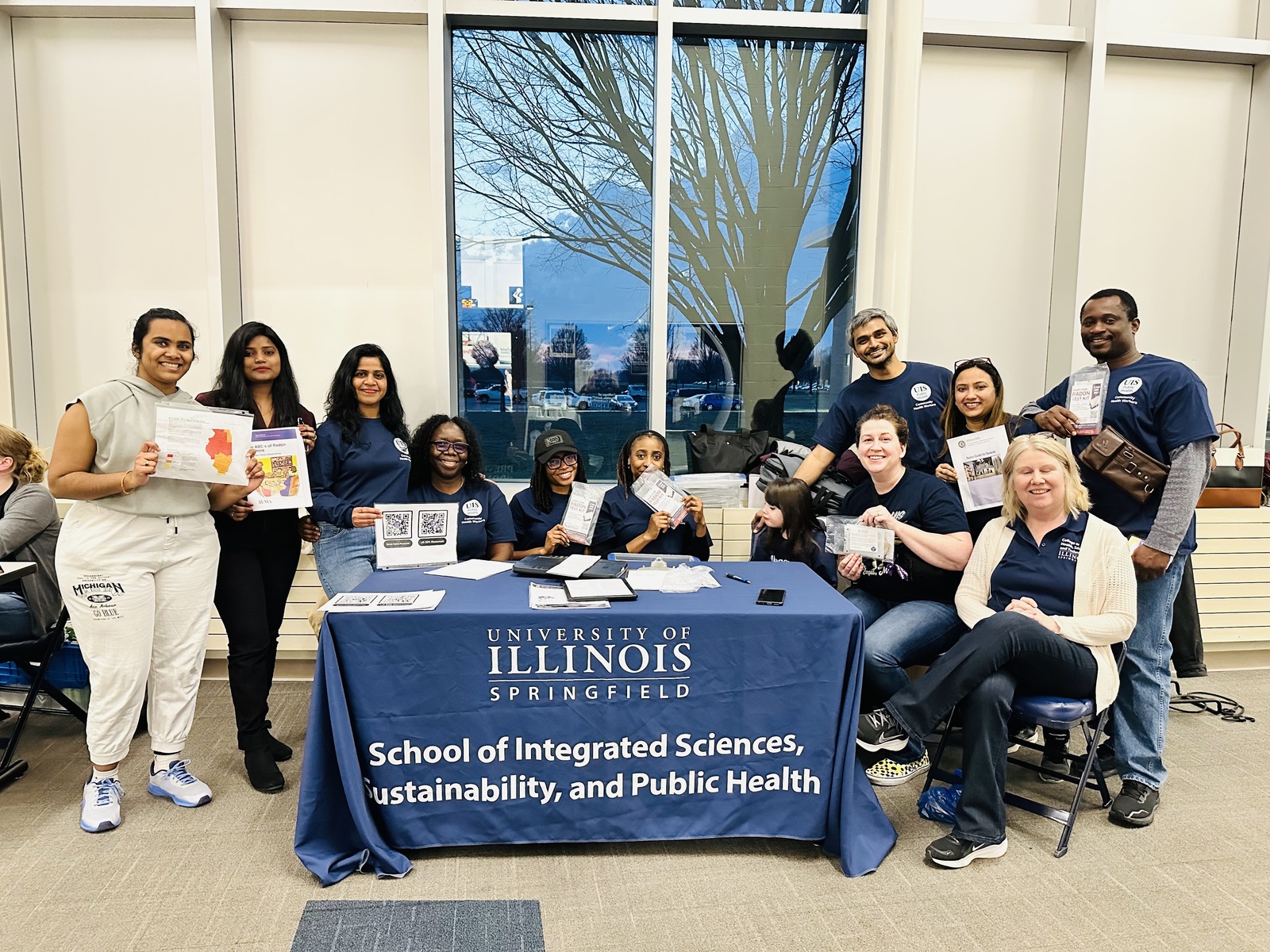
Support service and community-based learning opportunities in our public health program. Funds may be used to support students to participate in our radon research project or to purchase supplies to support additional community engagement. Dr. Madrigal leads a student research group that engages in service and community-based learning to support the goals of the Illinois Comprehensive Cancer Control Plan. Current efforts are focused on radon exposure; students are actively engaged in providing public health education and distributing radon testing devices within the region. Radon is an odorless, colorless, and tasteless radioactive gas produced from the radioactive decay of uranium found in rocks and soils. As it decays, radon releases radioactive particles and energy into the air. Breathing air that contains radon can cause cell damage in your lung tissue and potentially lead to lung cancer. As radon travels through the soil, it can easily move through small spaces in a foundation and enter a building. This includes, but is not limited to, floor drains, sump pits, crawl spaces, foundation cracks and gaps around pipes and wires in residential homes and other buildings. Longterm exposure to high levels of radon is a risk factor for lung cancer. Students in the UIS public health program are learning how to conduct environmental sampling, summarize data and report results, and design, implement, and evaluate public health programming related to radon awareness, testing, and mitigation. These activities are in partnership with state-wide leaders at the Illinois Department of Public Health, the Illinois Emergency Management Agency, and the Regional Cancer Partnership of Illinois. Students have developed a knowledge survey that is currently being deployed at outreach events. Public education events are taking place at local libraries where community members can learn about radon, health risks, and testing services. Students provide demonstrations of short-term and long-term radon testing devices, as well as provide details on how to interpret results of the test and where to go for resources for mitigation.
This project allows students to engage in training in the community where they can practice putting their public health skills to work in a real-world setting. It also benefits our local community by increasing awareness of an environmental exposure that can cause cancer, and giving people the opportunity to test their homes for this agent. It also helps us to strengthen our campus partnerships with other organizations within our state and region.
Examples of how your gifts make a difference:
- $25 will buy one short-term radon test
- $50 can provide two short-term radon tests within the community.
- $50 can support a student to prepare and deliver a community-engaged health education session
- $100 can support two students to prepare and deliver a community-engaged health education session